
Quikly + Klaviyo: Capture More Emails and Drive More Sales Without a Deeper Discount
Most Shopify merchants we talk to are stuck on the same trade-off:
“I want a bigger email list and more immediate sales — but I don’t want to keep increasing my discount to get them.”
It’s a fair worry. The usual playbook is a static “10% off your first order” popup feeding a Klaviyo welcome flow. It works, sort of, but the only lever you have left to pull is a bigger number — 15% off, then 20%, then free shipping on top. Margin goes down, and the offer stops feeling special.
Quikly changes which lever you pull. Instead of competing on discount size, you compete on urgency: scarcity, real time limits, social proof, and FOMO. The same offer captures more emails and drives more immediate purchases — because shoppers are responding to “only the next 50 get this” rather than “this is 5% better than the last popup I saw.”
This post is the playbook for pairing Quikly with Klaviyo to do exactly that. We’ll cover:
- How Quikly and Klaviyo fit together
- The popup play: a daily redemption cap that lifts your email capture rate
- Segmenting Quikly signups inside Klaviyo
- The flows that matter most — and where urgency belongs in each
- The cart abandonment play: an offer that decays the longer someone waits
- Measuring what actually moved (revenue, not opens)
1. How Quikly and Klaviyo fit together
Section titled “1. How Quikly and Klaviyo fit together”Quikly captures emails through urgency-driven campaigns on your storefront — popups, banners, teasers, and checkout. Klaviyo is where those subscribers land and where your automated flows nurture them into buyers. The integration connects the two so every email a Quikly campaign collects flows straight into the Klaviyo list you choose, in real time.
Connecting takes about a minute via OAuth — no API keys, no scopes. We won’t re-document it here; the step-by-step lives in the Klaviyo integration guide. Once you’re connected, this post picks up where that guide leaves off: turning those subscribers into revenue.
One thing worth doing before you launch: set the connected Klaviyo list to single opt-in so subscribers are added immediately and your welcome flow can fire without waiting on a confirmation click. (Details are in the integration guide.)
2. The popup play: capture more emails without a deeper discount
Section titled “2. The popup play: capture more emails without a deeper discount”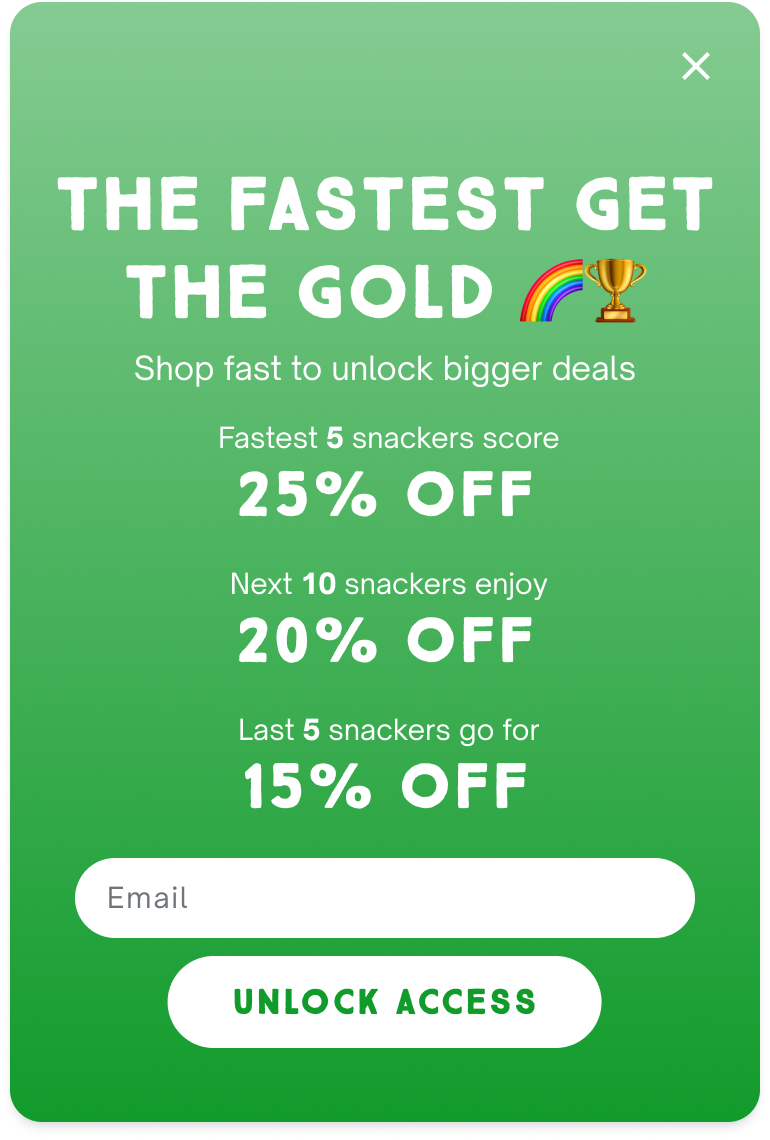
Here’s the mechanic that makes Quikly different from a standard email-capture popup.
In a Quikly campaign you can set a redemption cap — a limit on how many shoppers can claim the offer. Pair that with a live countdown (“only the next 50 get this”) and a timer, and the popup stops being a passive “enter your email for 10% off.” It becomes “claim this before it’s gone.”
That reframing is the whole point. A shopper who would have ignored a flat 10% popup will hand over their email to lock in a capped offer — because the scarcity, not the discount size, is doing the persuading. You capture more emails at the same discount you were already willing to give.
A few ways merchants run this:
- Sitewide welcome unit — your standard list-growth popup, but with a capped, time-boxed reward instead of a static code.
- Exit intent — trigger the capped offer as a shopper moves to leave, turning abandonment into a last-second opt-in.
- Daily caps for repeat urgency — set the cap so it can reset on a cadence (“first 50 each day”), which keeps the FOMO fresh for returning visitors and gives you a recurring reason to drive traffic to it.
The shoppers you collect this way tend to convert better downstream, too — they opted in during a moment of urgency, so they’re primed to respond when your Klaviyo flow follows up. For more campaign structures, see Campaign Ideas.
3. Segmenting Quikly signups inside Klaviyo
Section titled “3. Segmenting Quikly signups inside Klaviyo”Once subscribers are flowing in, you’ll want to treat Quikly-sourced contacts differently from the rest of your list — they came in hot, and your flows should reflect that.
Quikly writes a few properties to each profile it syncs, which makes segmentation easy:
quikly_source— always set toquikly; the simplest way to isolate every Quikly-sourced contact.quikly_campaign_id— the specific campaign that captured the signup.quikly_campaign_name— the human-readable campaign name, handy when you’re building segments by hand.
The subscription itself is also tagged with a source of Quikly in Klaviyo.
To build a segment of Quikly subscribers:
- In Klaviyo, go to Lists & Segments and click Create New Segment.
- Add a condition on Properties about someone →
quikly_sourceequalsquikly(or filter byquikly_campaign_namefor a specific campaign). - Save, and you have a living segment you can target with campaigns or use to trigger Quikly-specific flows.
This lets you, for example, send a different welcome series to people who came in through a high-urgency capped offer than to your general newsletter signups.
4. The flows that matter most — and where urgency belongs
Section titled “4. The flows that matter most — and where urgency belongs”These are the four Klaviyo flows worth optimizing for Quikly subscribers. The Klaviyo-side mechanics are standard; what’s different is where you let urgency do the work.
Welcome flow
Section titled “Welcome flow”Your first touch after someone joins. Engagement is highest here, so it usually drives the most revenue of any flow. If your Quikly campaign delivered a code with an expiration window, your first welcome email should fire immediately and carry that code so the shopper can redeem before it lapses. Quikly generates and manages standard Shopify discount codes for you, so there’s nothing to set up manually in the Shopify admin — see how codes are generated and delivered.
If the urgency window has already closed by the time you’re following up, switch the message: acknowledge they missed the flash offer and point them at a fresh Quikly campaign rather than quietly handing out the same discount with no time pressure. The scarcity is the reason to act now.
Browse abandonment flow
Section titled “Browse abandonment flow”Triggers when someone views products but doesn’t add to cart. Instead of bolting on a bigger discount to win them back, link them to a capped Quikly offer. The message becomes “the deal you were eyeing is going fast” — urgency, not a markdown, closes the gap.
Cart abandonment flow
Section titled “Cart abandonment flow”The highest-leverage flow for urgency, and the one we dig into next. These shoppers were one step from buying; a time-sensitive, decaying offer is far more persuasive than a flat “10% off, come back anytime.”
Post-purchase flow
Section titled “Post-purchase flow”Nurture the relationship after the sale — reviews, recommendations, and the next reason to come back. A capped Quikly offer for repeat buyers (“first 100 returning customers”) gives loyal shoppers a reason to act now instead of waiting for your next sitewide sale.
5. The cart abandonment play: an offer that decays as they wait
Section titled “5. The cart abandonment play: an offer that decays as they wait”This is the second mechanic that lets you drive sales without a deeper discount — by making waiting cost the shopper something.
A typical Klaviyo cart abandonment flow sends a reminder, then a bigger discount a day later if they still haven’t bought. That trains shoppers to wait: they learn that hesitating earns them a better deal. You’re paying more to close the same sale.
Quikly inverts that. You point the cart-reminder email at a Quikly activation whose offer tiers down over time — the best discount goes to the fastest buyers, then it steps to a lower tier, and a live countdown shows where things stand:
- First to act: the strongest offer (e.g. $20 off).
- Wait a while: it steps down to the next tier (e.g. $15 off).
- Keep waiting: the lower tier, or it closes out entirely.
Now hesitation is expensive instead of rewarded. The shopper has a concrete reason to come back and check out now, and you never had to widen your discount to create that pressure — the structure does it. Because the campaign is gated to an activation link, you can keep this offer exclusive to the abandoning-cart segment and measure it cleanly. (More on link-gated audiences in the FAQ.)
A note on how this fits together: Klaviyo owns the trigger and the send (the cart abandonment flow, timing, and email content), and Quikly owns the offer behind the link (the tiers, the cap, the countdown, and the code). You build the flow once in Klaviyo and let the Quikly campaign supply the urgency.
6. Measure what actually moved
Section titled “6. Measure what actually moved”The reason to run urgency over a deeper discount is incremental revenue — so measure that, not opens and clicks.
Quikly’s A/B testing is built in and reports on revenue lift, which lets you put a capped or decaying Quikly offer head-to-head against your current flat-discount baseline and see which one actually produces more revenue per send. Run a tiered Quikly offer against your existing “10% off” cart reminder for a couple of weeks and let the revenue numbers settle the question. See the Overview for how lift reporting works.
In short
Section titled “In short”You don’t have to choose between a bigger list and protecting your margin. Quikly’s urgency mechanics — caps, tiers, countdowns, and link-gated offers — give you a second lever beyond discount size:
- A capped popup captures more emails at the discount you already offer.
- A decaying cart-reminder offer drives faster checkouts without training shoppers to wait for a better deal.
- Klaviyo handles the segments, flows, and sends; Quikly supplies the urgency behind the link.
Ready to wire it up? Start with the Klaviyo integration guide, then browse Campaign Ideas for offer structures that match your goal this week.